

The global loss of nature is a key driver of financial risks that can affect your business. Companies face regulatory risks linked to the negative impacts that they may have on biodiversity and ecosystems through their core operations, supply chains and investment decisions. At the same time, many organisations depend on the goods and services provided by nature for their inputs and processes. As the impacts of climate change and other environmental shocks increase, many sectors of the economy can thus become more exposed to risks such as increased cost of raw materials and supply chain disruptions.
To be able to act on biodiversity and gain a competitive advantage, companies need first and foremost to have an in-depth understanding of how their activities and business models interact with nature. Once they have assessed their nature-related impacts and dependencies, they should develop strategies and targets for managing the related risks along their value chains. Finally, they should move beyond simply mitigating their impacts, and transition to nature-positive business models that can help them capitalise on new opportunities, such as access to new markets and cost savings through resource-use efficiencies.
KPMG can offer in-depth subject matter knowledge to help you integrate nature-related topics in your strategies, business models, operations and reporting efforts. For example, we can help you understand what regulators expect you to report on, and how you can articulate your biodiversity performance clearly. We can also help you undertake assessments of your biodiversity impacts, dependencies and risks along your value chain or in your portfolio. Finally, we can help you set science-based targets for nature and develop a detailed biodiversity strategy and transition plan.
Nature is the foundation of our economies and societies. Either directly or indirectly, all businesses depend upon the goods and services provided by nature, including raw materials, clean water, fertile soils, climate regulation, and protection against extreme weather events. As a result, it is estimated that over half of the world’s gross domestic product could be potentially threatened by the ongoing loss of biodiversity, which together with climate change and pollution represents one of three key pressing planetary crises.
For companies, the benefits of assessing and managing the impacts that they may have on nature go beyond regulatory compliance. The advantages for early movers can include direct cost savings through resource-use efficiencies, reduced exposure to environmental and climate risks, and new revenue streams such as those offered by nature-based solutions and emerging markets for biodiversity credits. In other words, the transition to a nature-positive trajectory can become a major market opportunity, estimated to unlock USD 10 trillion annually by 2030. Furthermore, taking action on biodiversity is increasingly important to meet stakeholder demands, as evidence suggests that investors and lending institutions are increasingly incorporating nature-related information into their financing decisions.
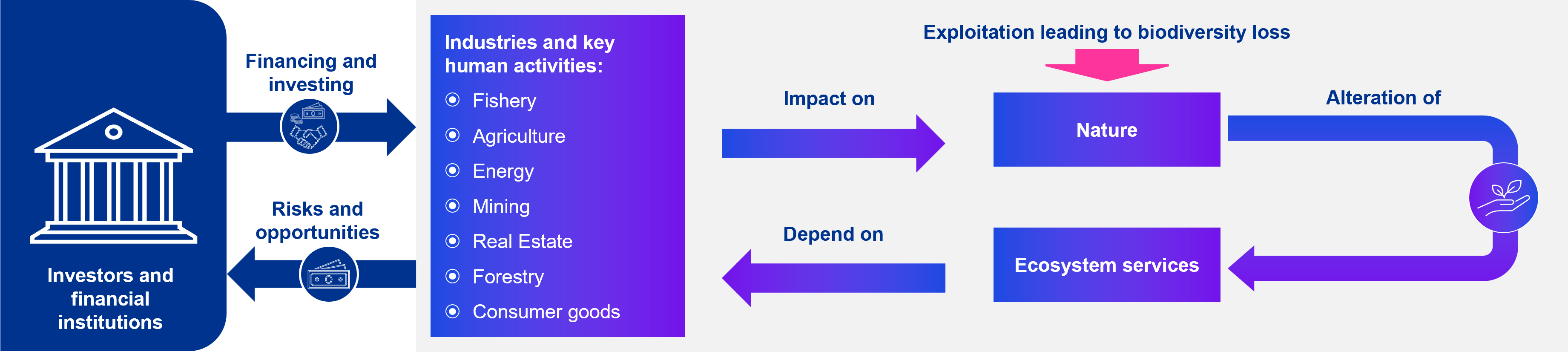 Indirectly or indirectly, all businesses impact, or depend upon, the availability and quality of the goods and services provided by nature. Source: KPMG.
A growing number of regulatory and voluntary initiatives are shaping business action on biodiversity
In recent years, in connection with the adoption of global policy frameworks such as the 2030 Agenda for Sustainable Development and the Kunming-Montreal Framework of the Convention on Biological Diversity, there has been increased recognition of the role that companies should play in the fight to halt and reverse the loss of biodiversity. At the European level, the EU Biodiversity Strategy to 2030 and other associated strategies under the European Green Deal have stated the business case for minimising impacts on biodiversity and investing in nature conservation and restoration, while simultaneously emphasising the importance of better integrating biodiversity considerations in business decision-making.
These global and regional calls have already led to new regulations and demands on companies, ranging from the EU Nature Restoration Law to the United Kingdom’s requirements on biodiversity net gain. In the EU, such calls have also prompted the inclusion of biodiversity in broader efforts to steer private sector finance and investments towards sustainability, as illustrated by the EU Taxonomy for Sustainable Activities, the European Green Bond Standard and the EU Sustainable Finance Disclosure Regulation.
Finally, they have inspired initiatives aimed at identifying, assessing and managing nature-related financial risks and opportunities, from the Corporate Sustainability Reporting Directive (CSRD) and its ESRS E4 standard to voluntary frameworks such as the Task-force on nature-related financial disclosures (TNFD), the Science-based targets for Nature guidance (SBTN) and the revised GRI 101: Biodiversity 2024 standard. While many of these initiatives have, as their primary aim, to increase the transparency and comparability of nature-related disclosures, they can also help companies to improve the availability and quality of data as a starting point for better incorporating nature into their strategies and business models.
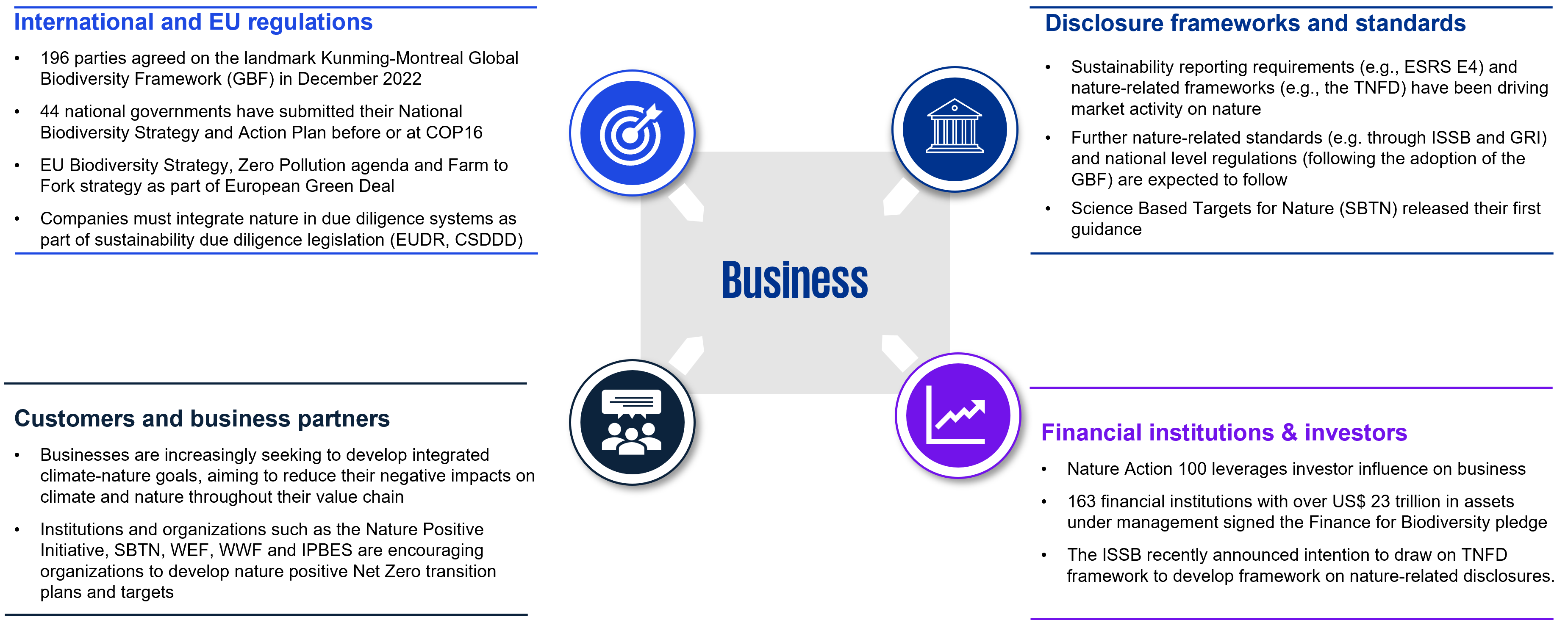 Regulatory frameworks are only one of the nature-related drivers impacting businesses. Source: KPMG, based on World Economic Forum (2023).
KPMG can help you integrate nature in your strategy
At KPMG, we offer a combination of subject matter knowledge and industry insights to help you understand and approach this growing area of corporate sustainability. If you are starting with your nature journey, we can develop trainings to enhance understanding of nature-related topics among your internal stakeholders, offer cutting-edge advisory on biodiversity regulatory compliance, and benchmark your biodiversity performance against that of your competitors.
Thanks to our expertise in biodiversity data and tools, we can perform in-depth assessment of nature-related impacts, dependencies, risks and opportunities along your value chain or in your portfolio, following established methodologies such as the LEAP approach developed by the TNFD. As biodiversity represents a key topic under several emerging sustainability due diligence regulations, such as the EU Deforestation Regulation (EUDR) and the Corporate Sustainability Due Diligence Directive (CSDDD), we can also help integrate nature in your due diligence systems and processes. Finally, we can assist you in developing science-based targets for nature and biodiversity strategies and transition plans, and help you align your biodiversity reporting with key mandatory and voluntary frameworks (e.g. ESRS, TNFD, GRI). In our work, we collaborate with providers of cutting-edge data solutions, to ensure that you can benefit from the best-available tools and evidence when taking action on biodiversity.


